
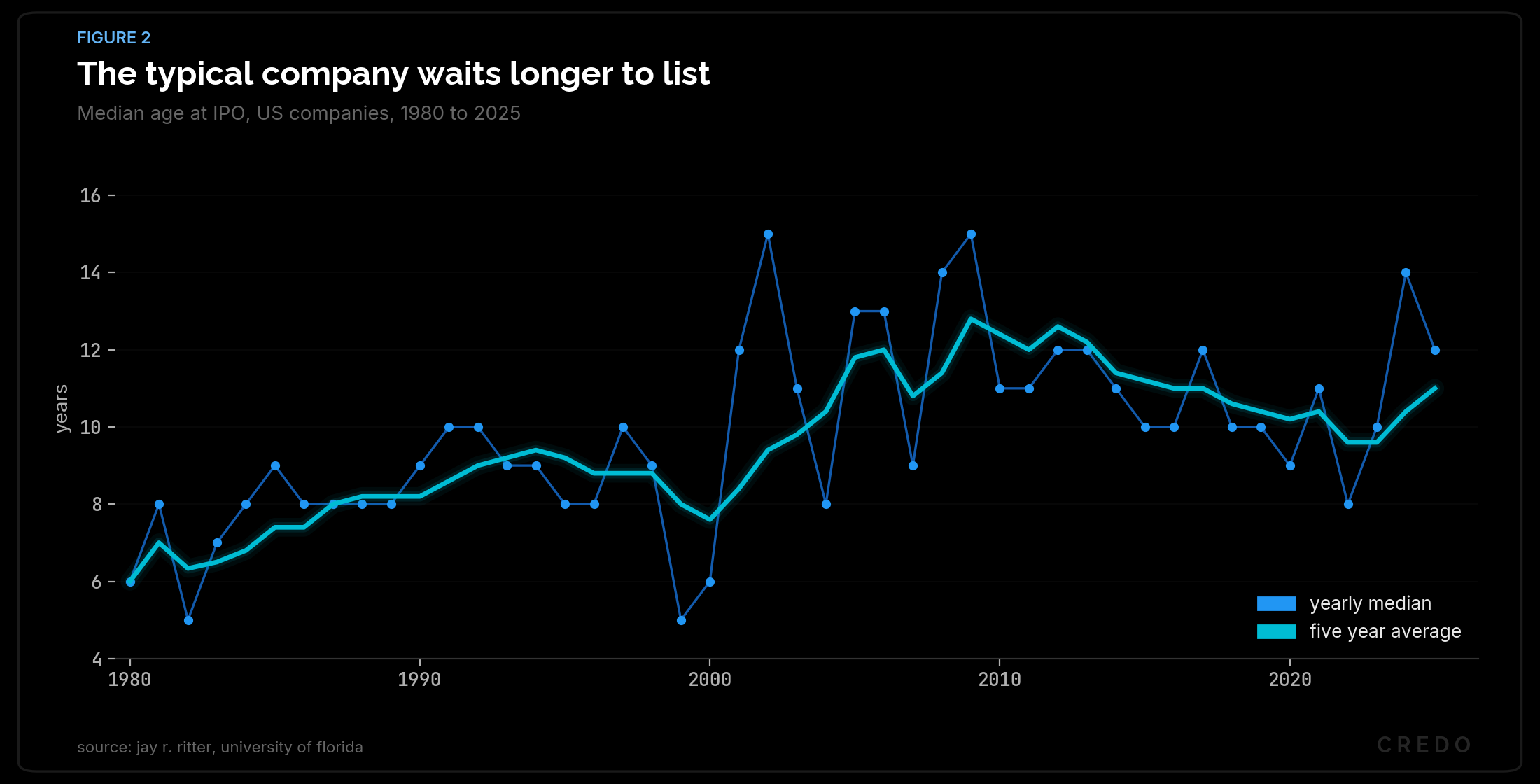
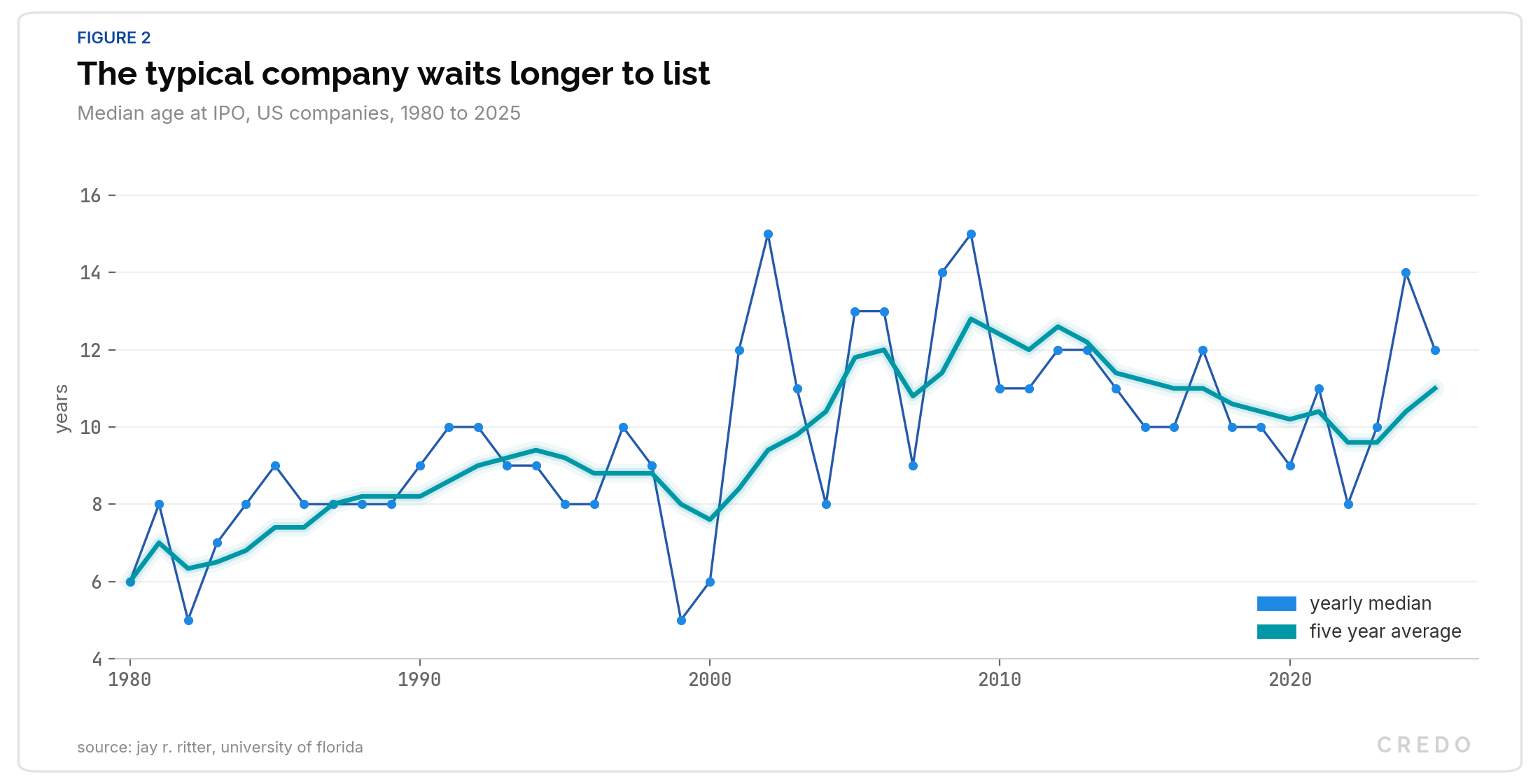
- Companies list later and larger than they used to. The median US company now goes public at 11 years old, against 8 in the 1980s. Amazon listed at $438 million. SpaceX listed at $1.77 trillion. The demand for exposure before the listing is structural.
- A pre-IPO perpetual is a cash settled futures contract with no expiry on a company with no public shares. With no stock to anchor it, each venue has to build its own reference price. That choice decides your funding, your margin and your liquidation.
- Listing day settles nothing. The reference switches to the live stock and the same contract carries on.
- Across five completed listings, the perp traded above the IPO price for its entire life, and all five stocks opened above their IPO price. The level was an approximation. In the final hours, as the contract met the much larger exchange market, its volatility rose two to five times.
01Amazon listed at $438 million. SpaceX listed at $1.77 trillion.
When Amazon went public in May 1997, the entire company was worth $438 million. Anyone with a brokerage account could buy it that week. Almost everything Amazon became was built in public, and public shareholders owned it while it happened.
SpaceX went public on June 12, 2026 at $135 a share. The company was worth $1.77 trillion at that price and the offering raised $75 billion, the largest on record. SpaceX had been valued at a little over $10 billion in early 2015 and at $800 billion in an employee tender six months before the listing. Every step of that climb happened in private rounds. The public was invited in at the top of it.
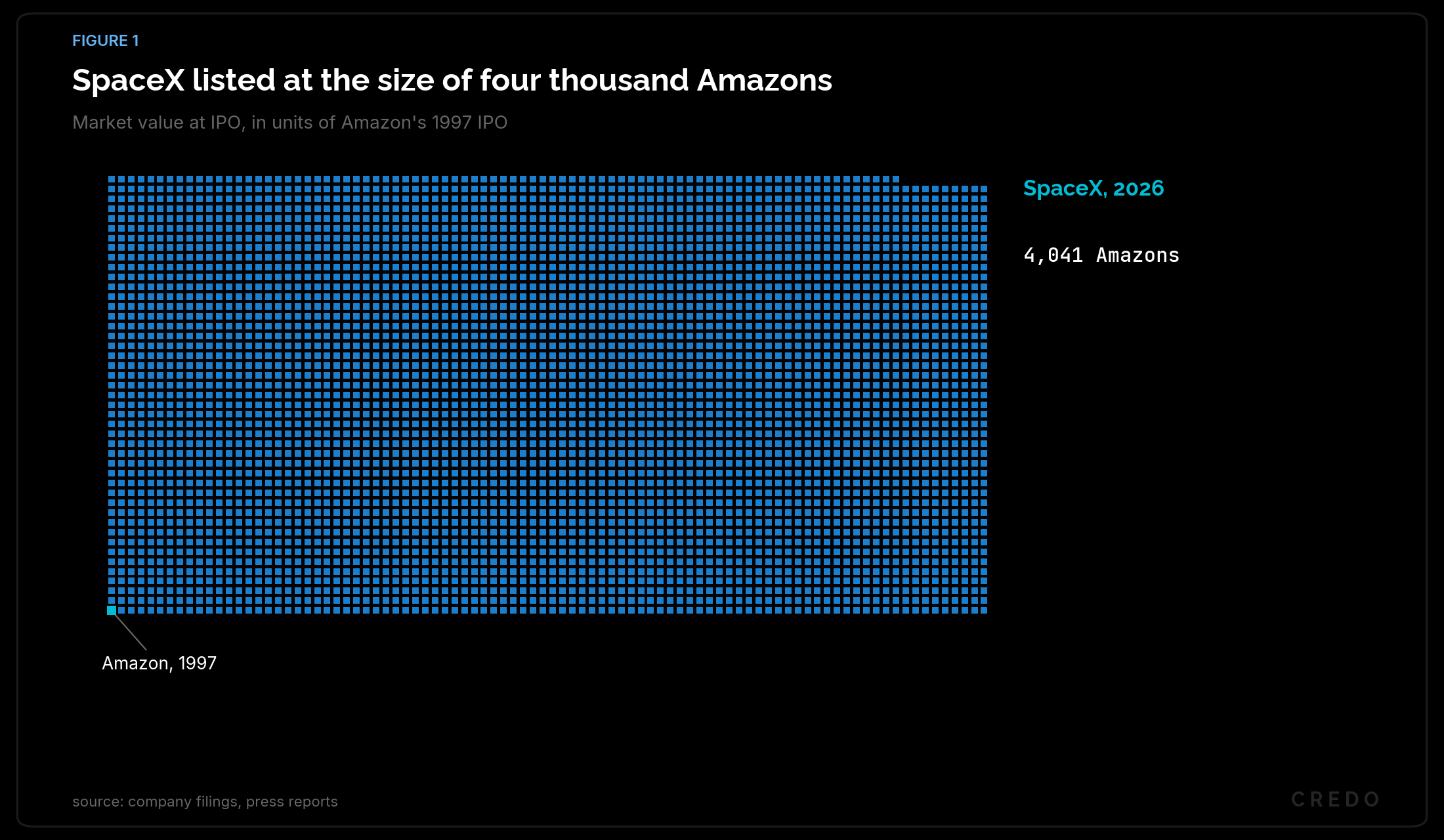
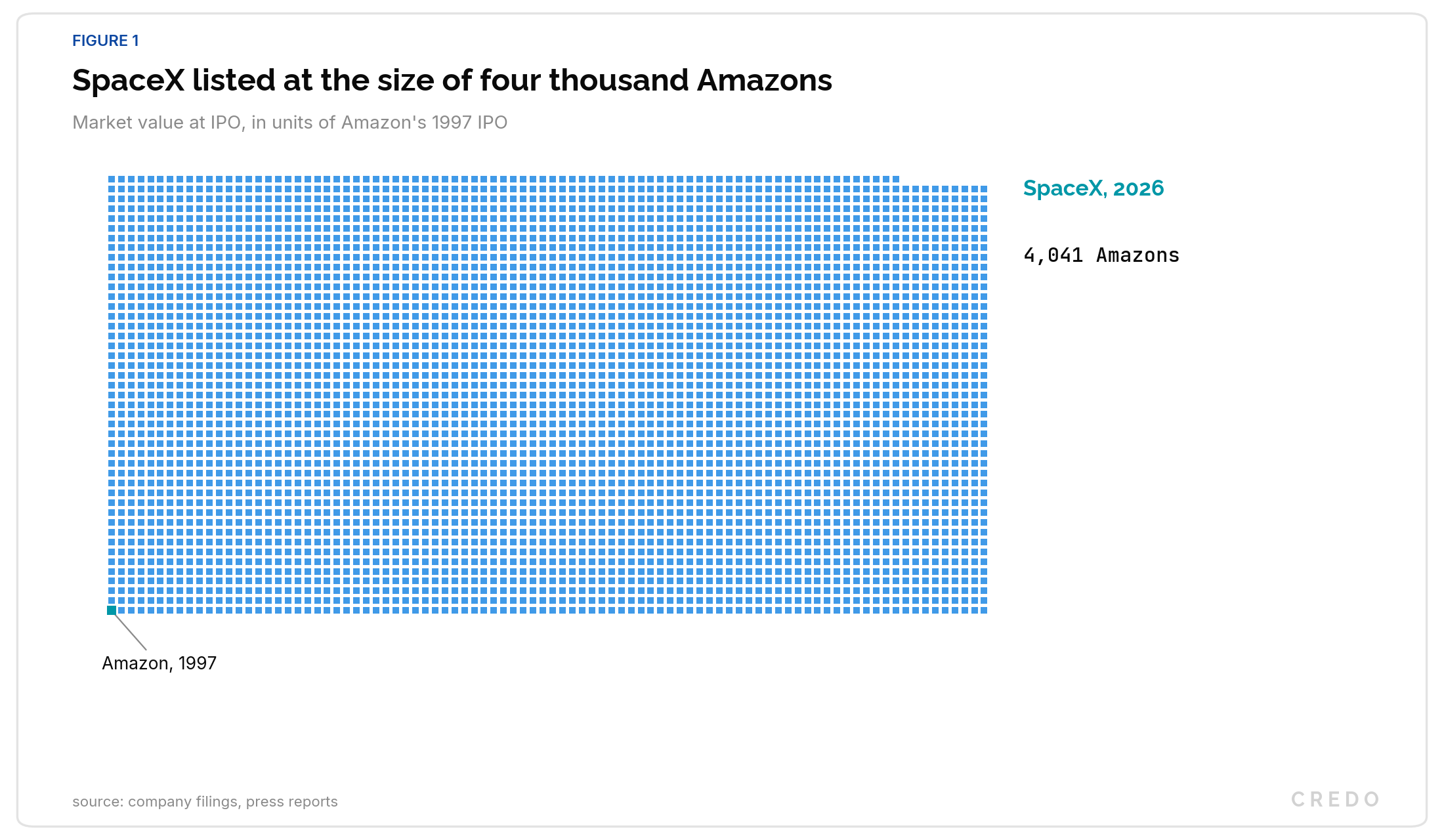
This is not a SpaceX story. It is the pattern, and the data on it is long and consistent. Jay Ritter's IPO database at the University of Florida covers 9,343 US offerings since 1980. The median company that listed in the 1980s was 8 years old. Since 2001 it is 11, and in 2024 it was 14. There are fewer listings to choose from as well: 677 in 1996, 90 in 2025. By the SEC chairman's own count, the number of companies listed on US exchanges has fallen by roughly 40% since the mid-1990s, when there were more than 7,000.
The reasons are familiar to anyone who has watched the private markets grow. Private capital became deep enough to fund a company to almost any size. Anthropic raised $65 billion in one private round this May. A decade of cheap money sent institutions looking for growth outside the listed market. And the rules moved. Facebook was pushed into its 2012 listing partly by a rule that forced SEC registration once a company had 500 shareholders of record. The JOBS Act, passed the same year, lifted that to 2,000, or 500 who are not accredited investors, and stopped counting shares issued under employee compensation plans. A company could now stay private with thousands of holders.
So the question a growth investor used to ask, "when can I buy it," has become "how do I get exposure before it lists." The market has been answering that for fifteen years, imperfectly. Secondary platforms and brokers sell blocks of private shares, with fees that can exceed 7% and settlement measured in months. Special purpose vehicles pool money to buy a stake, often stacked two or three deep. At least 170 of them sold SpaceX interests before the listing. Tokenized versions appeared on public blockchains, and both Anthropic and OpenAI have said that share transfers into such structures are void.
In May 2026 a different kind of answer arrived. It involves no shares at all.
02A futures contract on a stock that does not trade
A perpetual, or perp, is a futures contract with no expiry. A crypto exchange introduced it in 2016 and it has since become the dominant instrument in that market: roughly 84% of crypto derivatives volume, about $116 billion a day in August against $17 billion for dated futures.
It won for a simple reason. A dated future has to be rolled, and its price relative to spot depends on which month you hold. A perp removes both problems. Instead of converging to spot at expiry, it is held near spot by a payment called funding. When the perp trades above its reference price, longs pay shorts. When it trades below, shorts pay longs. The payment is small and frequent, hourly on most venues. If you trade futures, think of funding as the basis, paid continuously instead of realized at the roll. It is the better design, and the traditional venues will adopt it in time.
Two reference prices sit behind every perp.
Oracle price. Most exchanges call this the index price; oracle is Hyperliquid's term for the same thing. The value the contract is trying to track, normally an index of spot prices from several venues. Funding is measured against it.
Mark price. The venue's estimate of the contract's fair value, used to margin positions and to decide liquidations. It does the job of a clearinghouse settlement price, computed every few seconds instead of once a day.
Now apply this to a company that has not listed. There is no spot price. Nobody can buy the share and sell the perp, so the arbitrage that normally pins a derivative to its underlying does not exist. Until the listing, the contract behaves like a dated future whose expiry is the first exchange trade, on a date nobody has fixed.
Someone has to decide what the oracle is in the meantime. That decision sets the funding you pay, the mark you are margined on, and the price at which you are liquidated. It is the whole design problem, and each venue has solved it differently.
03Who builds these markets
Most of the design work has happened on Hyperliquid, a blockchain built to run an exchange. Its order books, margin accounts and liquidation engine are part of the chain itself. In October 2025 it opened that infrastructure to outside teams under a framework called HIP-3. Any team that stakes 500,000 HYPE tokens can list its own perpetual markets. At HYPE's price when the first pre-IPO markets launched that stake was worth about $27 million; at today's price it is closer to $45 million. Hyperliquid matches, margins and liquidates. The deployer chooses what to list, sets leverage and, most importantly, supplies the oracle price.
The nearest traditional analogy is an exchange that lists a contract and also runs the committee that sets its settlement price, on top of a clearinghouse it does not control, with a bond it forfeits if the validators judge it has behaved badly.
In practice one deployer has taken almost the whole market. trade.xyz handled 95% of HIP-3 volume in the second quarter and, by Coin Metrics's count, more than half of all volume on Hyperliquid in August. At the start of October it had 110 live markets and $3.9 billion of open interest, mostly in equity, index and commodity perps, and it was the first to list a pre-IPO perpetual, on Cerebras, on May 1. Its eighth, on Oura, is the only one live as this is written.
The other deployer that matters for this story is Entropy, which listed a perpetual on Anthropic on August 19. Next to trade.xyz it is small, with $38 million of open interest in that market at the start of October, and by that measure it is also the largest single venue for Anthropic perps anywhere.
The centralized exchanges followed within weeks: Binance listed a SpaceX contract on May 21, Coinbase's international exchange on June 3, and Kraken, OKX, Bitget and Gate have since added their own, so that by September 19 venues were quoting an Anthropic perp.
04Inventing the first price
The two Hyperliquid deployers took opposite approaches, and the difference explains most of what follows.
trade.xyz: the order book is the oracle. trade.xyz starts each market at a reference price it picks, a number its documentation describes as "discretionary" and "not a forecast." For SpaceX it chose $150. From that point on the oracle is derived from the market's own order book and nothing else, as a 30-minute moving average that drifts toward wherever real, executable size is resting, and the mark price is the median of three readings of that same book.
Since nothing external restrains the price, trade.xyz adds a limit of its own: the mark cannot move more than a set percentage from a reference level, and when it reaches the edge the reference steps up or down and a fresh band opens, a limited number of times.
You can watch this happen in the SpaceX contract's complete trading history, which Hyperliquid's public API still serves. The market opened at 22:00 UTC on May 17, and the first hour traded at $180.00, exactly 20% above the reference, which is the width of the band at 5x leverage. The second hour closed at $216.00, exactly 20% above that. In other words the market opened at its upper limit twice before it found sellers, at $230.
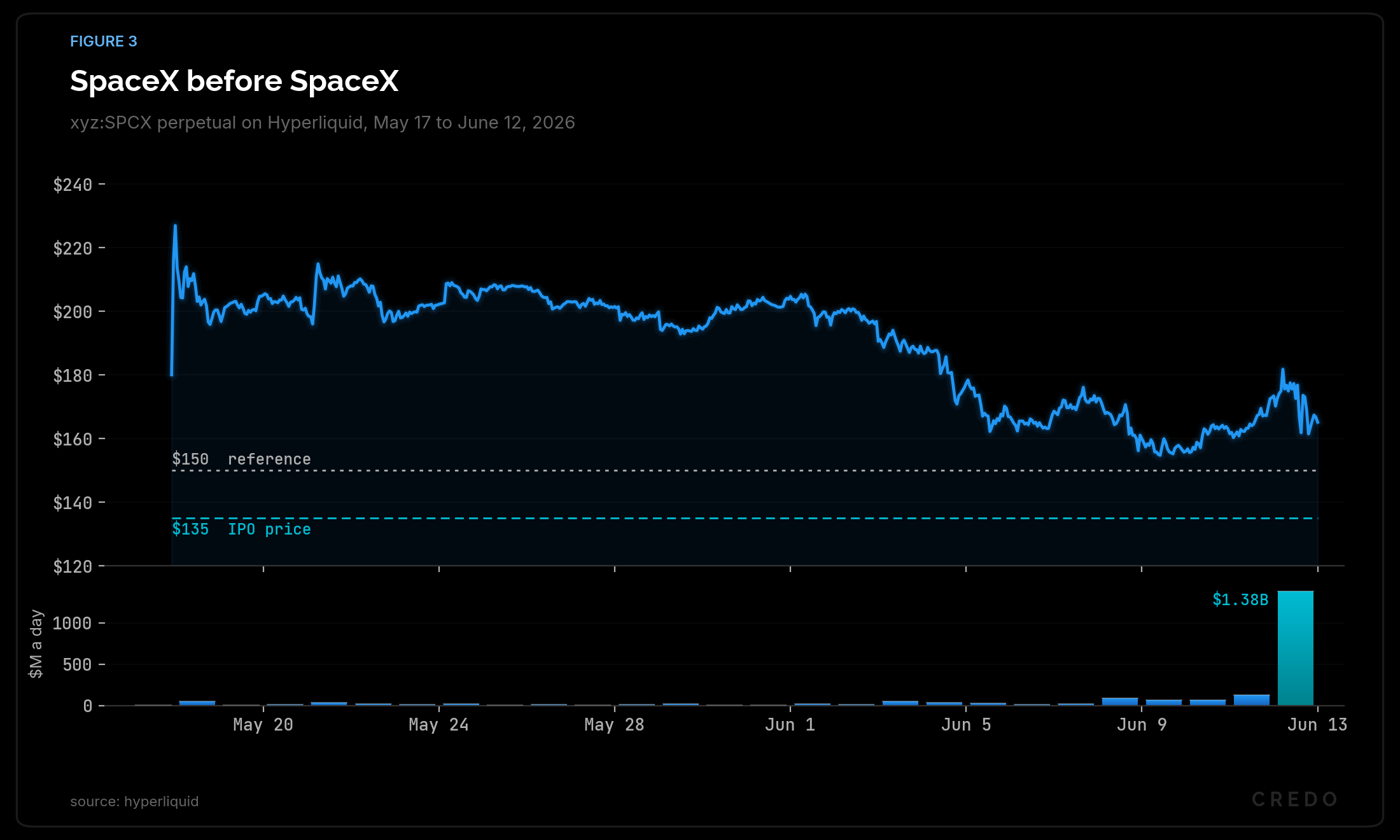
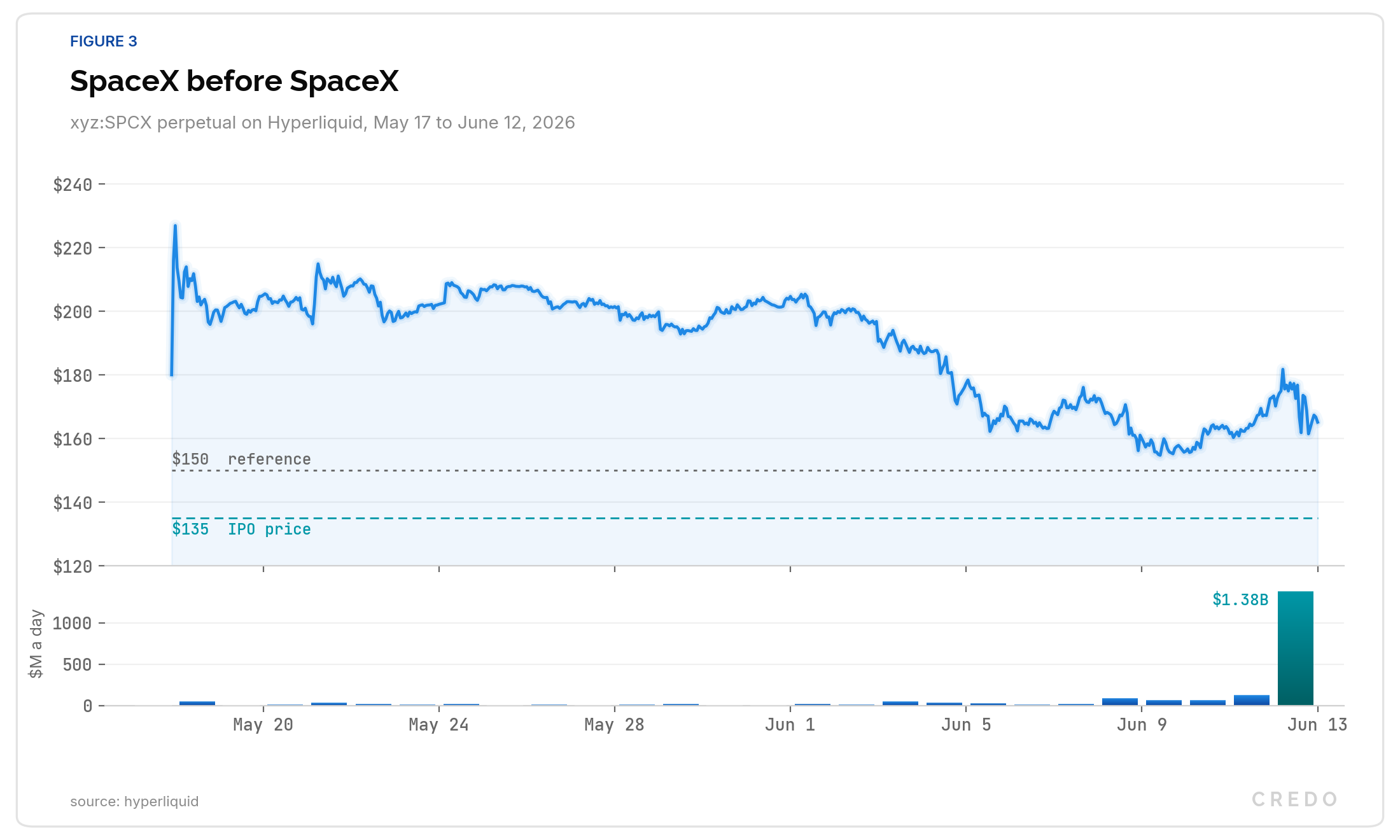
trade.xyz lists these contracts late and keeps them short, by design. Its stated policy is to launch only once the company is in the registered filing process, and the five markets that have completed their life existed for 1, 7, 12, 13 and 25 days before the listing. The timing is a trade. List too early and there is nothing to trade on: no range, no prospectus, a thin book and a long stretch of oracle and settlement risk for the deployer to carry. List close to the event and the market arrives when the information does. The volume bears this out. Nearly half of all SpaceX pre-listing trading on Hyperliquid happened in the last four days, and Cerebras traded more on listing morning than in its previous thirteen days combined.
Entropy: the order book plus an outside reference. Entropy quotes Anthropic as a valuation, where one point is $1 billion. At the start of October it traded near 2,085, an implied $2.08 trillion against a last private round at $965 billion. Its oracle blends two inputs, its own order book and an external aggregate of private market data supplied by RedStone, and the weights move with liquidity, so that when the book is deep the book gets up to 95% of the say and when depth disappears the outside reference takes over. The logic is that a liquid market should be allowed to price itself and an illiquid one should not be trusted to.
Entropy's contract is also built to last: it listed three months before Anthropic's prospectus became public and runs for two years from launch.
The exchanges. The centralized venues publish much less about their methods. Binance says its contract reflects "publicly available signals, such as private funding rounds and announced IPO price ranges," and assumes a share count of one billion to turn a valuation into a price, while Kraken says plainly that its index is derived from the contract's own market, because no external feed exists.
| trade.xyz | Entropy | Binance | |
|---|---|---|---|
| Quoted as | price per share | company valuation, $bn | price per share on an assumed share count |
| Price source before listing | its own order book | its own order book, plus outside private market data | "public signals," then its own trading |
| Listed | after the public filing, for days or weeks | months ahead, for up to two years | on the confidential filing |
| Max leverage before listing | 5x | 6x | 5x to 20x |
| Margin | USDC | USDC | USDT |
05Funding when there is nothing to anchor to
On a normal perp, funding does real work: if the contract trades rich to spot, arbitrageurs sell it, buy the underlying and collect the funding until the gap closes.
On a pre-IPO perp there is no underlying to buy, so funding still gets paid, only now against the venue's synthetic oracle. On trade.xyz that oracle is a lagged average of the market's own price, which means funding ends up comparing the price now with the price half an hour ago. It taxes fast moves, and that is all it can do, because nothing in the system knows what fair value is and so nothing can pull the contract toward it.
The venues understand this and have responded by shrinking the payment itself: trade.xyz sets pre-IPO funding at 1% of the rate it uses on listed stocks, Entropy uses one eighth of Hyperliquid's default rate, and OKX sets the premium component, the part of funding that responds to the gap between the perp and its reference, to zero.
For a futures trader this is probably the most important adjustment to make, because the instinct that funding will discipline a mispriced perp does not apply here. Until a real stock price exists, the contract trades on positioning and sentiment and nothing else.
06What price liquidates you
Liquidation on Hyperliquid runs off the mark price, checked every block, and at 5x leverage the maintenance margin is 10%, so a move of about that size against you in the mark closes the position.
Since the mark is downstream of the oracle, and the oracle is whatever the deployer built, the oracle is the main risk in the product, and this year has already produced two examples of what that means.
On July 27, trade.xyz's perpetual on SK Hynix, a listed stock, fell from $1,127.90 to $917.25 in seconds after a single share traded in a Korean pre market session about 30% below the prior close. The oracle relayed the print, as it was designed to, and roughly $60 million of positions were liquidated. trade.xyz reimbursed the losses and described the decision as one time and discretionary, while Hyperliquid's position was that the market is run independently by its deployer and that the protocol itself had performed correctly.
Two months earlier a different deployer, running a SpaceX market with an outside data vendor at one third weight in its oracle, saw that vendor mishandle SpaceX's stock split. The market fell 45% in minutes and recovered within the hour. That deployer has since closed.
Neither episode was a failure of the exchange engine. Both were a reference price doing exactly what it was configured to do. On a traditional futures exchange there is a rulebook for this situation: policies for erroneous trades, price limits set by the exchange, and a clearinghouse with a default fund standing behind the result. On these markets the remedy was the deployer's goodwill, which is worth pausing on. A deployer that makes traders whole after an oracle error does so voluntarily, after the fact, and with no obligation to do it again. The one structural protection HIP-3 provides, the 500,000 HYPE bond that validators can slash for malicious operation, is a penalty on the operator rather than a fund for the people on the wrong side of a bad print.
07Listing morning
The question that comes up most often from people who trade listed derivatives is how these contracts settle: at the opening print, the opening midpoint, a VWAP, or the offer price?
On trade.xyz the answer is none of them, because the contract does not settle at all. When the stock starts trading, the oracle switches from the internal mechanism to the live share price, funding goes back to its normal setting, leverage is raised, and the same contract carries on as an ordinary equity perp with every position untouched. Binance does the same and smooths the mark over a period of up to three hours. The derivative, in other words, outlives the event it was created for.
If the listing never comes, trade.xyz allows a 60-day grace period and then settles at the average price over the contract's whole life, while Entropy's Anthropic market runs until August 2028 and, if there is still no listing by then, settles at a six month average of its own price. Should a listing be announced, Entropy's oracle switches to a one hour average of the mark three days beforehand, then to the public share price once one exists.
What happens to the price on the morning itself is the part that interests us most, because we traded it.
A Nasdaq IPO does not open at 9:30. The stock sits in a quote only period while orders build, and during that window Nasdaq publishes an indicative opening price and order imbalance every five seconds, with the lead underwriter deciding when to release it. For a large deal this takes an hour or two, and the indication moves as the book fills.
SpaceX priced at $135 on the evening of June 11, and the perpetual on Hyperliquid closed that day at $172.84. At 10am in New York on June 12 it was at $177, with early indications reported from trading desks around $175. Over the next two hours the indication came in, and the perp came in with it, trading as low as $152.34 in the hour the stock opened, just before noon. trade.xyz's own figure for the last price before the first trade is $157.59, and the stock opened at $150.
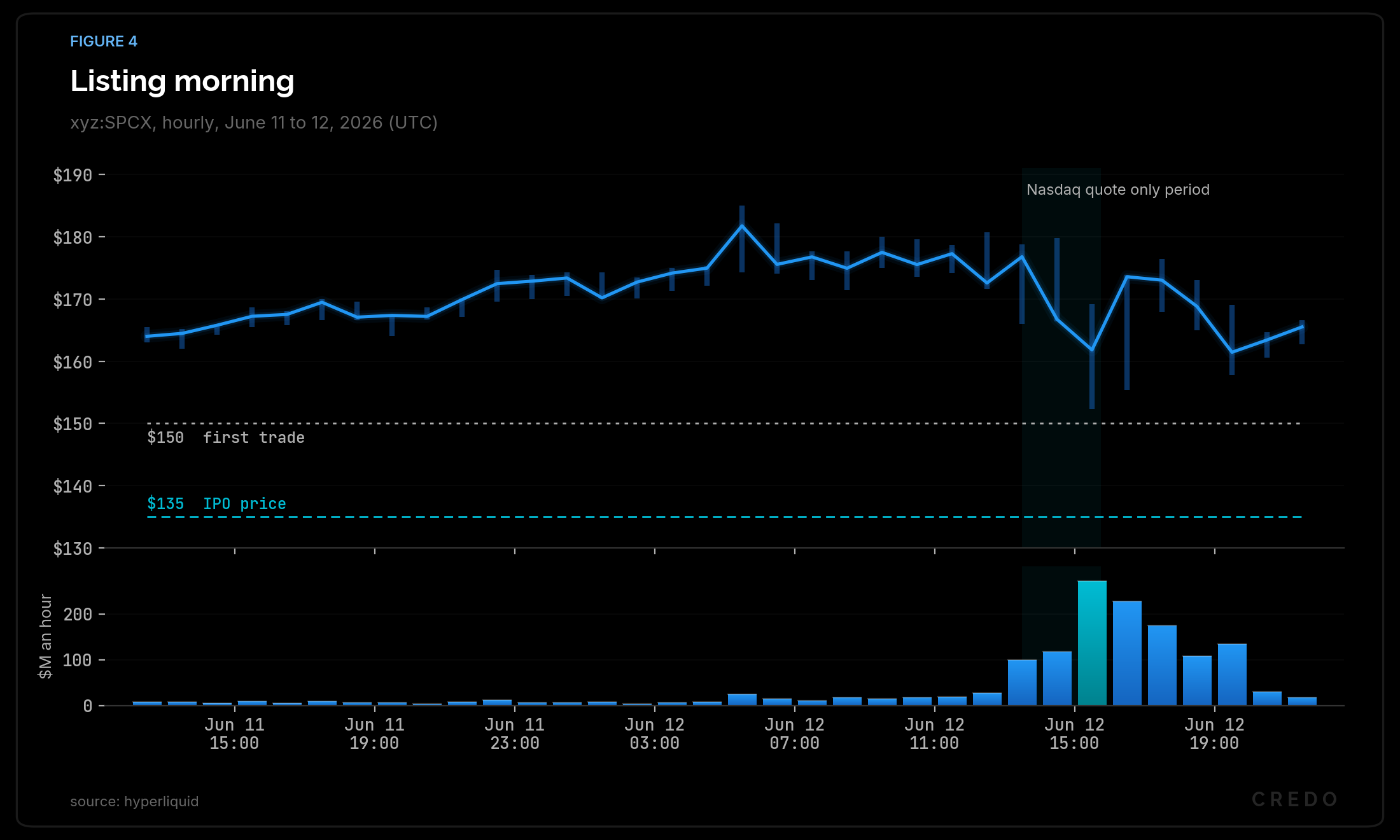
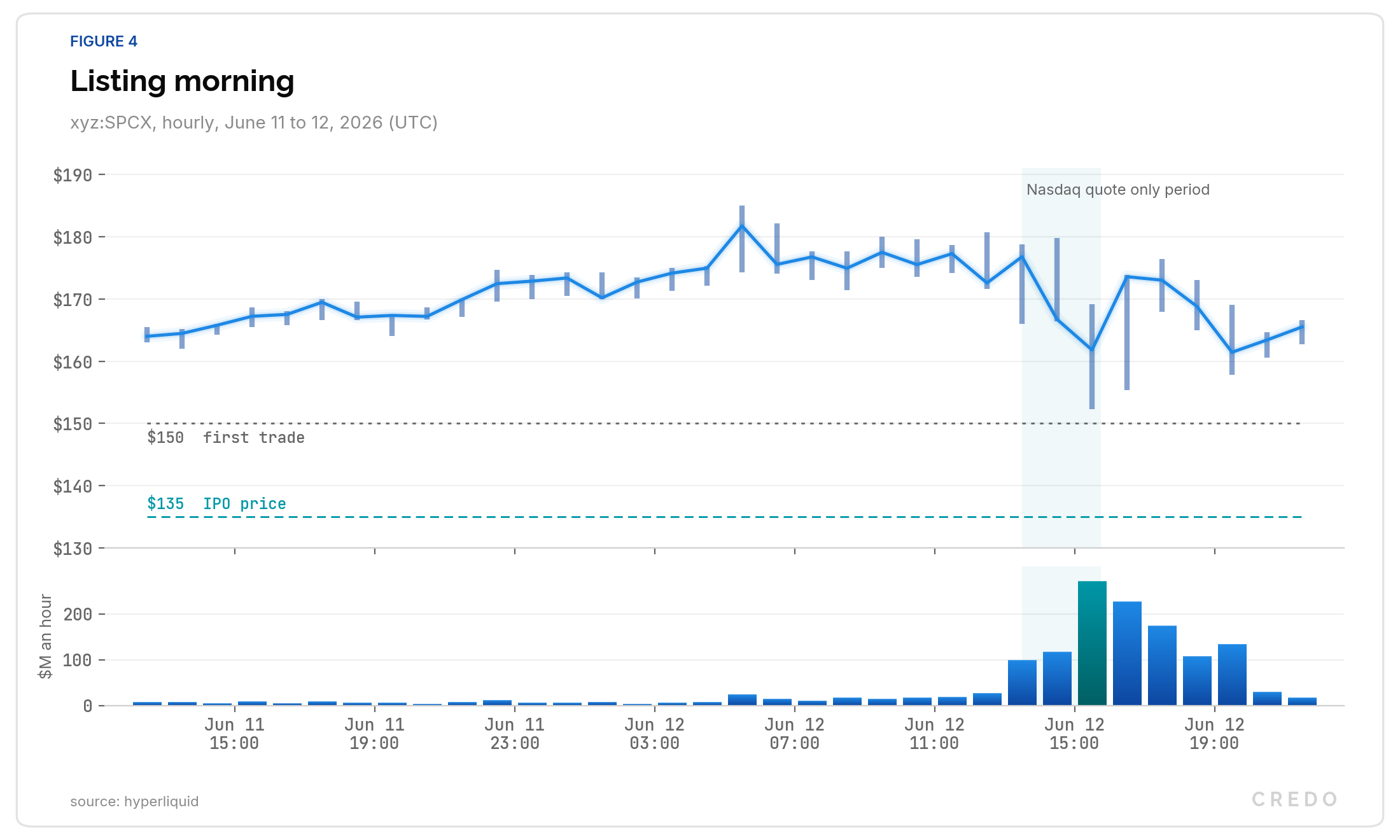
From the desk, the sequence was clear: as Nasdaq's indication firmed, the perp reconciled to it. A market that had traded $800 million in a month was meeting one that would trade $85 billion that day, and the smaller one did the moving.
08A thermometer, and a good one
Five of trade.xyz's pre-IPO markets have now run their full course: Cerebras, Quantinuum, SpaceX, an SK Hynix depositary share and CXMT in Shanghai. Their hourly histories are all still available from Hyperliquid's public API, and while five listings is a small sample and should be read as one, three things stand out from it.
The direction was right every time. In all five markets the perp closed above the eventual IPO price in every hour it traded before the listing, and all five stocks then opened above their IPO price. Anyone reading these markets knew, days or weeks ahead and for free, that each offering was priced below where demand sat, a read that before 2026 belonged only to the banks running the book.
The level was an approximation, tighter for some than others. Take each contract's hourly price over its whole life and measure how far it sat from where the stock eventually opened: the typical gap was 4% for SK Hynix and 9% for CXMT, then 19% for Cerebras, 33% for SpaceX and 44% for Quantinuum. The SpaceX number is not a misprint. The contract spent most of May between $195 and $210, a third above the $150 the stock opened at, and only came down in the final ten days. What the perp gives you, then, is a reading of mood and conviction: which side of the offer price the market leans to, and roughly how hard. It is not a quote for the opening print.
The reason comes down to size. The SpaceX perp traded $801 million on Hyperliquid in the 26 days before listing and perhaps $2.5 billion across every venue, whereas the stock traded about $85 billion on its first day. Cerebras traded $48 million in its 13 days as a pre-IPO market. A market of that scale aggregates the views of the people who can reach it, while the opening auction aggregates everyone, including every institution that did or did not get an allocation.
When the two markets meet, the small one moves, and it moves fast. As the listing exchange begins publishing its indicative price, the perp closes the gap, and trade.xyz's own filing with the SEC gives the numbers: a day before listing the perp was 12% to 43% away from the opening price in four of the five markets, and minutes before the first trade it was within 0.4% to 7.2% in all five.
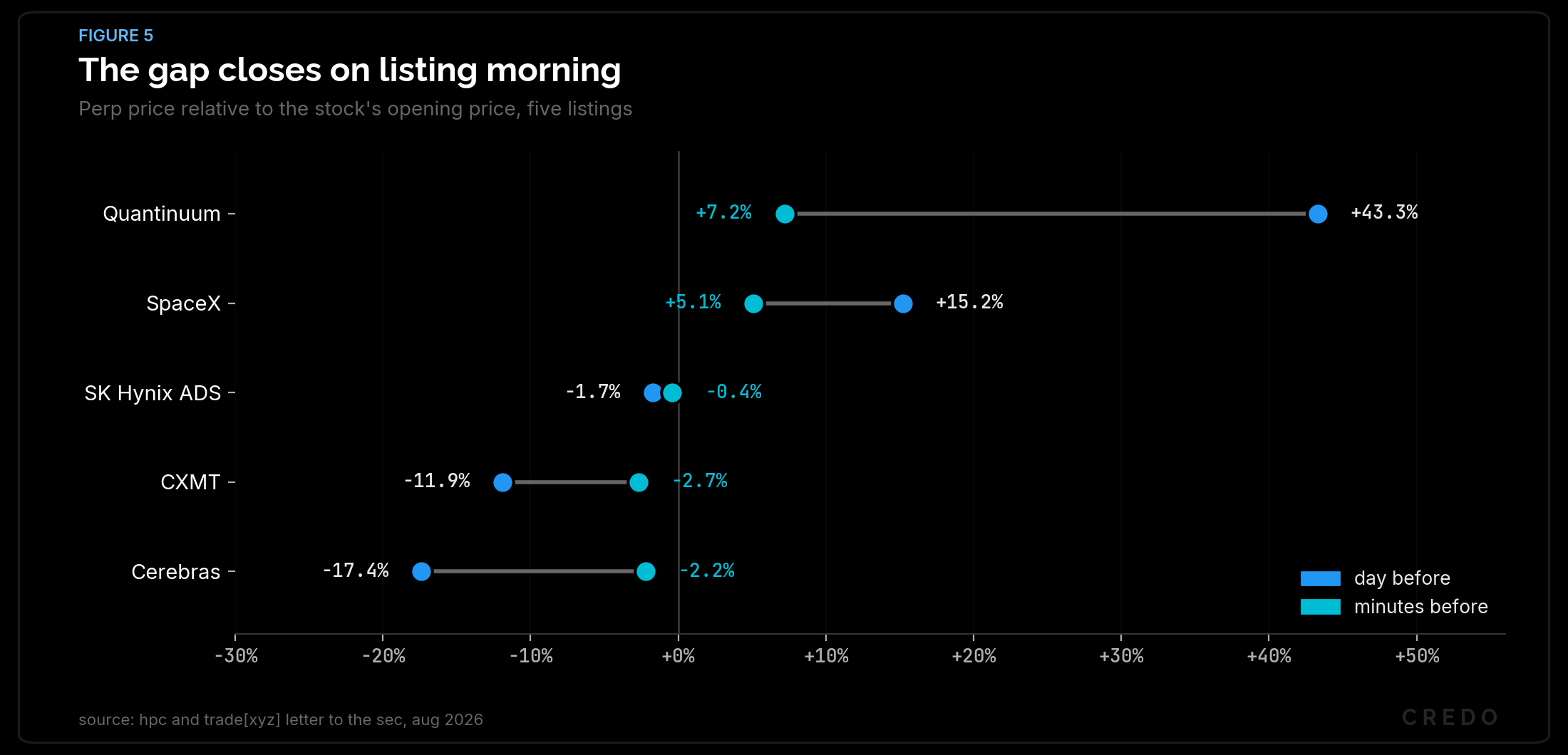
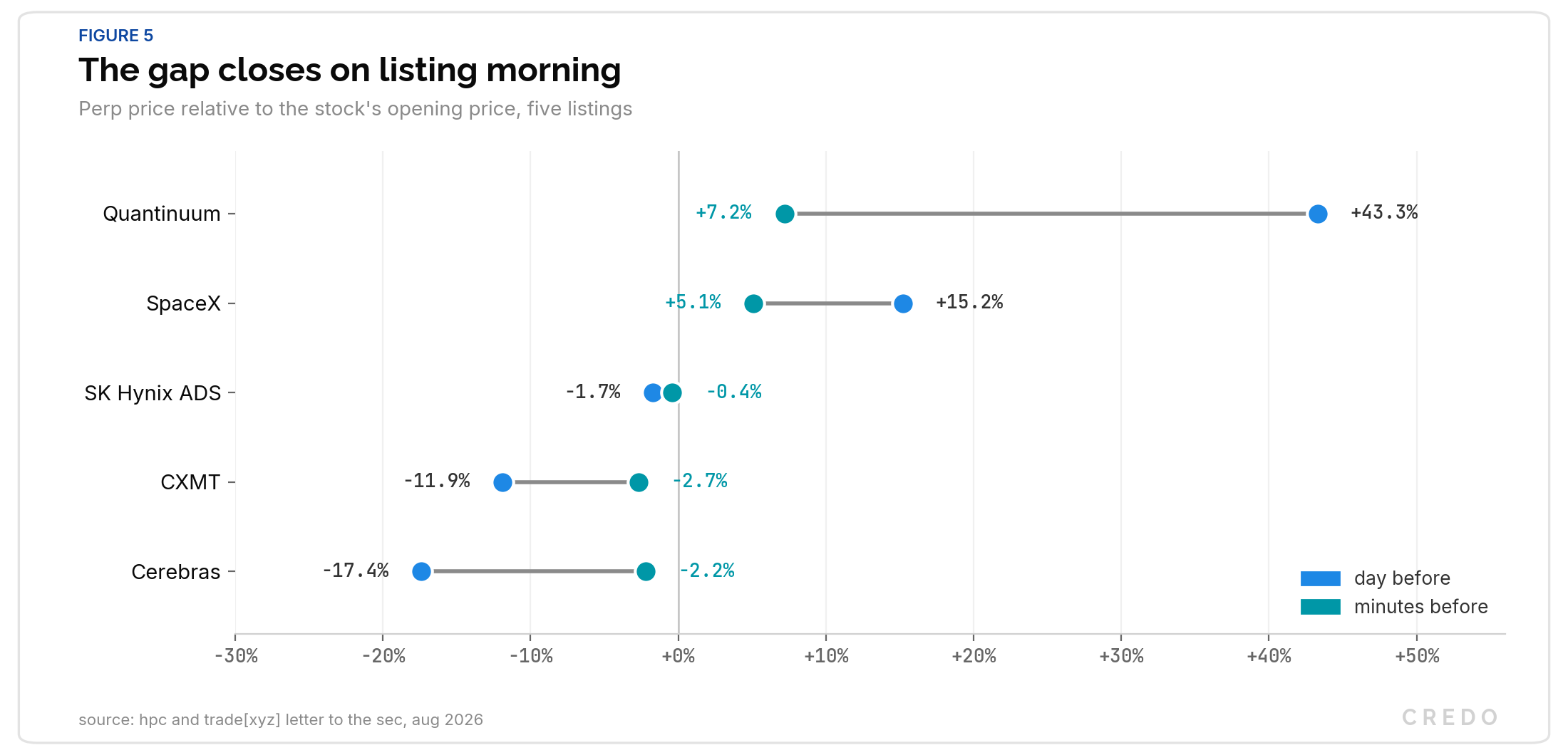
As you would expect, that convergence is not gentle. In every one of the five markets, the average hourly trading range in the last three hours before the first exchange trade was two to five times its normal level: on SpaceX it went from 1.3% an hour to 6.7%, and on Cerebras from 4.8% to 18.1%, while volume in those hours ran between 5 and 290 times the hourly average.
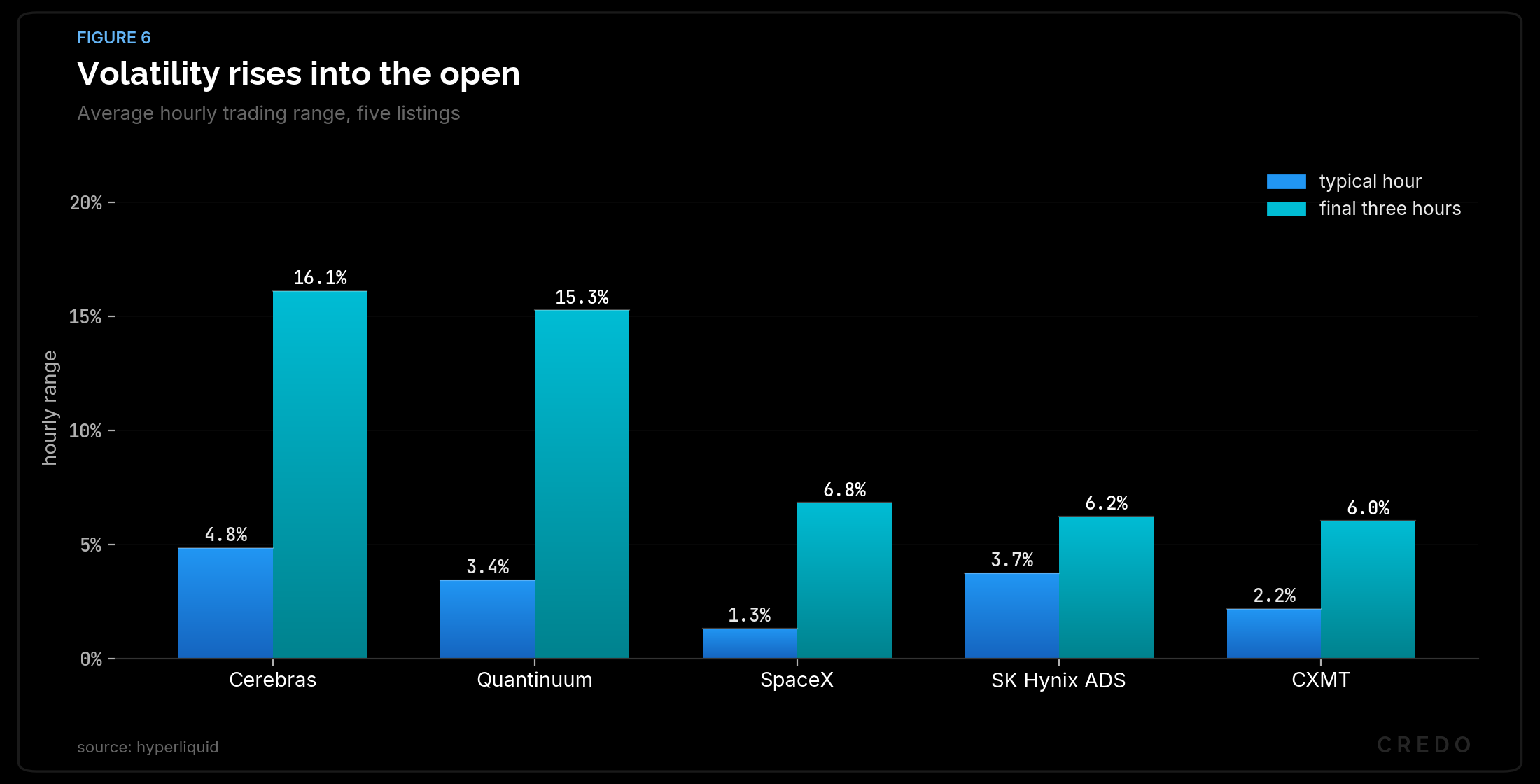
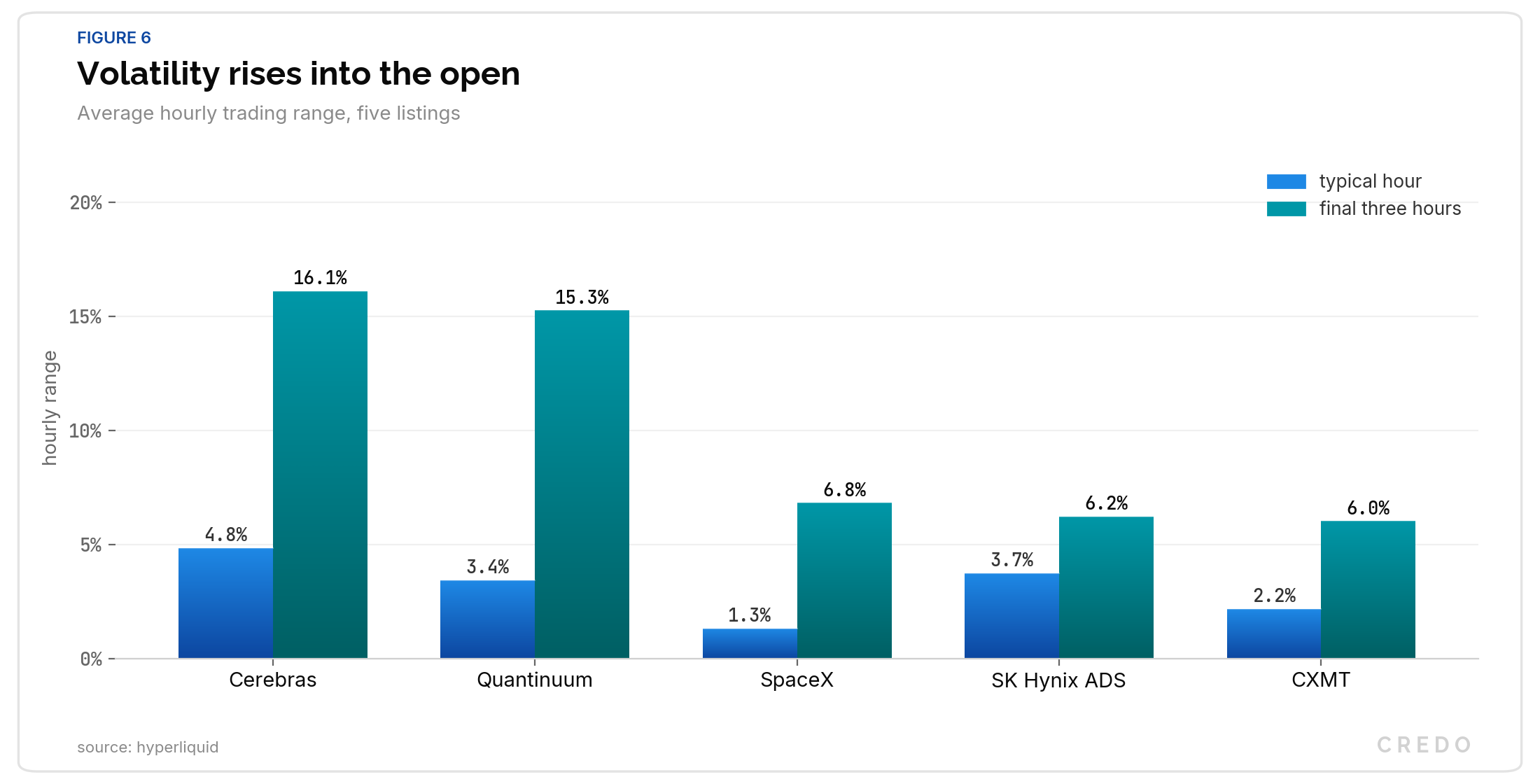
Cerebras shows it most clearly. The contract closed the day before listing at $289, and between 10am and 11am New York time it traded $84 million, more than in its entire prior life, while moving from $298 to $370. The stock opened at $350. Quantinuum went the other way, from $97 the day before to $91 at 10am and $70 inside the next hour, against an open of $68.
For anyone holding a position this is the practical point: the hours before the open are the most volatile of the contract's life, and they come with 5x leverage and a 10% maintenance margin, so a 7% hourly range is most of the way to a liquidation.
There is a useful comparison on the same venue. trade.xyz's perps on listed stocks and commodities keep trading through the weekend, when the underlying market is closed, on the same internal pricing, and Blockworks Research studied 614 of those weekends. It found the on chain price was a good forecast of Monday's open, and that it did not reprice when the exchange's own pre open indication appeared, because it had already absorbed the news. The difference from the pre-IPO case lies in what each market is pricing: a weekend market prices an asset with years of history and two days of information to digest, while a pre-IPO market prices something that has never traded. The first can get close on its own. The second approximates, then reconciles.
None of this should be read as a flaw. It is what happens when a continuous market that has been running on sentiment is handed a reference price by a market many times its size. trade.xyz and the Hyperliquid Policy Center argue in their SEC letter that these contracts produce a public price signal that did not exist before, and as far as direction goes the record is on their side, five times out of five.
09Who is on the other side, and can you hedge?
Access tells you most of what you need to know. Hyperliquid has no accounts in the usual sense: there is no application and no identity check. A trader connects a wallet, deposits USDC and trades, and the only gate is the website turning away visitors from the United States and other restricted countries by location. The exchange versions are offshore, and each carves out a different list of countries, so the accessible crowd is global retail and trading firms that already operate in crypto.
The people with the most reason to hedge are not allowed to, because SpaceX's lockup restricts "short sales, hedging, and similar transactions," and Cerebras's covers "swaps or similar arrangements that transfer the economics of the stock," which describes a pre-IPO perp exactly.
For everyone else the constraint is size. Open interest in the SpaceX contract across all venues peaked around $250 million before listing, against a $1.77 trillion company, and the deployers cap it by design, so the market can absorb a position of a few million dollars and not the hedge a fund with a real stake would need.
There is also a basis problem. Until the listing, the contract has nothing to track except the market's own view of the company, and that view moves on its own: the SpaceX perp fell from $216 to $153 in the three weeks before the listing while the deal itself did not change. Anyone short the perp against private shares would have made money on the hedge while nothing happened to the shares, and the reverse can happen just as easily.
10What a traditional trader will not expect
The contract terms belong to the deployer. The reference price, the price bands, the funding setting, the leverage and the margin mode are all set by the team that listed the market, and they have changed from one listing to the next. A deployer can also halt a market and settle every position at the current mark.
The listing may not come. OpenAI's chief executive said on September 12 that the company will not go public this year, and its perpetual on Hyperliquid fell 16% over the next two days before recovering most of the move. It still trades on 18 venues with no listing date. trade.xyz told the SEC its product "is not designed to, and cannot, become a standing synthetic market in private company equity." Others have built exactly that, and in a no IPO outcome each one settles against its own trading history.
The market never closes and the stock does. Four days after listing, SpaceX closed on Nasdaq at $192.50, and the perpetual traded up to $228.74 that night.
The legal status is open. These contracts are not offered in the United States, and the deployers' own letter states that a perpetual on a single company's equity "falls within the Commission's jurisdiction" as either a security based swap or a security future. In 2016 the SEC fined a platform for selling cash settled contracts on pre-IPO companies without registration, and the SEC and CFTC have since asked for comment on how to classify equity perpetuals without yet answering the question.
What is not a risk is worth stating too. No shares move, so the company's transfer restrictions are not engaged. Collateral and positions sit on a public ledger, and the matching and liquidation engine behind them has processed hundreds of billions of dollars.
11What to watch when Anthropic lists
The reason these markets exist is not going away. Companies will keep listing late and large, investors will keep looking for a read on them before the bell, and a leveraged, cash settled contract that opens when the prospectus is filed and converts into a normal equity perp on listing day is a clean piece of engineering that has now worked through the largest IPO in history.
What it offers is a continuous public reading of where sentiment sits, weeks ahead of a listing, with real money behind it. In five listings out of five it pointed the right way. On level it is an approximation and should be read as one, because the opening auction is a far larger market, and when the two meet the perp will move quickly toward it.
Anthropic meets investors this month and is expected to list in November. Its perpetuals imply about $2 trillion, double the last private round, and its listing will be the first test of a contract that has traded for months instead of days, and the first for Entropy's blended oracle.
We will be watching two things: which side of the offer price the perp sits on once that price is set, and how wide its hourly range gets on listing morning.
12Appendix: data and method
Data. Price and volume history for the five converted trade.xyz markets (CBRS, QNT, SPCX, SKHY, CXMT) and for Entropy's markets comes from Hyperliquid's public API (the info endpoint), hourly and daily candles. Open interest and leverage figures are from the same source. Notional volume is base volume multiplied by each candle's typical price. Prices described as "the day before" and "minutes before" a listing are from the comment letter filed with the SEC by the Hyperliquid Policy Center and trade.xyz on August 18, 2026, checked against the hourly data where the two overlap.
Opening hour. The public API does not serve minute data for the period, so each stock's first exchange trade is placed in the hour of peak perp volume on listing day, cross checked against the SEC letter. "The final three hours" are the three hourly candles before that hour; "a typical hour" is the average of all hours from launch until a day before it.
Gap to the opening price. The perp's hourly close relative to the stock's opening price, at fixed points before the first trade.
| 5 days | 3 days | 24 hours | 6 hours | 1 hour | Minutes before | |
|---|---|---|---|---|---|---|
| Cerebras | -19.6% | -21.5% | -12.8% | -17.6% | -2.2% | -2.2% |
| Quantinuum | +47.2% | +46.0% | +50.0% | +44.0% | +15.2% | +7.2% |
| SpaceX | +15.7% | +3.8% | +11.5% | +18.3% | +11.1% | +5.1% |
| SK Hynix ADS | n/a | n/a | -6.3% | -4.4% | 0.0% | -0.4% |
| CXMT | -6.6% | -11.4% | -16.5% | -13.9% | -9.3% | -2.7% |
The last column is from the SEC letter. The SK Hynix market existed for one day.
Limits. Five listings in three months, four of them in one sector and one market cycle. All five were priced below demand and all five rose on day one, so the sample contains no case of a perp trading below an offer price that then held. The figures describe what happened. They do not establish what will.
CREDO is a proprietary trading firm specializing in digital assets. This article is for information only and is not investment advice.
← Back to home